
The first call with a home fragrance manufacturer goes badly for a predictable reason, and it is not nerves. Founders arrive without having decided the handful of things the supplier needs in order to answer usefully, so the conversation stays at the level of general reassurance. An hour of preparation before the call turns it into a working session. The five items below are the ones that change what you get out of it.
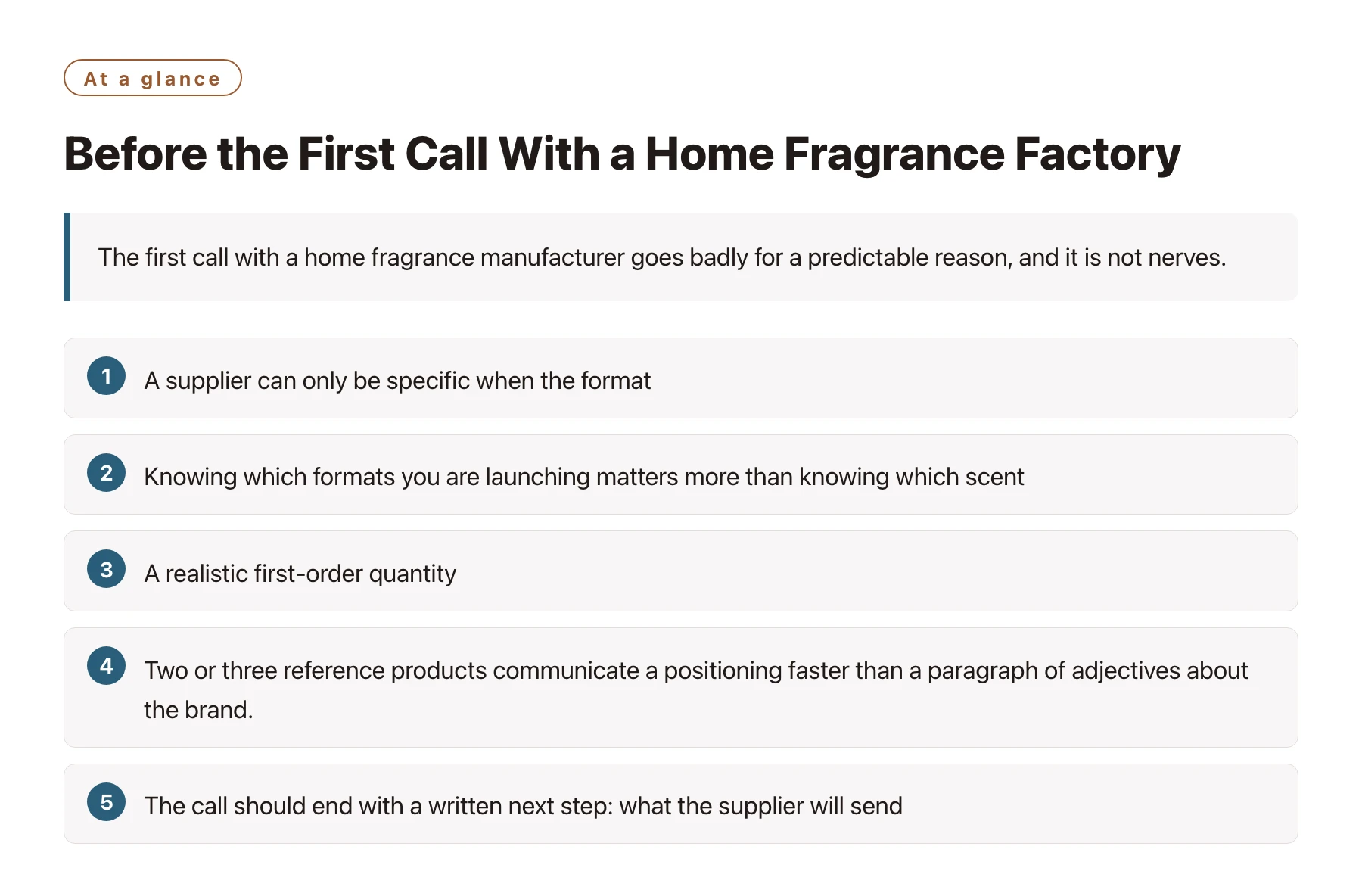
Key takeawaysA supplier can only be specific when the format, the volume band and the target price are already decided, even provisionally. · Knowing which formats you are launching matters more than knowing which scent, because the format decides the base, the filling line and the testing. · A realistic first-order quantity, rather than an aspirational one, is what produces a usable price and timeline. · Two or three reference products communicate a positioning faster than a paragraph of adjectives about the brand. · The call should end with a written next step: what the supplier will send, and what you will send back.
Founders often postpone the first manufacturer conversation because it feels premature. The brief is not finished, the formula does not exist, and the brand name may still be provisional. Waiting does not help, because most of what a manufacturer needs is structural rather than creative.
This is a short preparation list rather than a sourcing guide. It assumes you have picked up the phone and want the call to produce something you can act on the same week.
The call works when you have already decided something
A useful supplier conversation sounds like a series of constraints being tested, not a presentation. The manufacturer is trying to work out which of its existing capabilities fits your project, and that question cannot be answered while every variable is still open.
You do not need answers that will survive the year. You need provisional positions that are honest about being provisional, because a decided constraint can be discussed and a vague one cannot.
There is one thing worth doing before the call rather than during it, and that is a short review of how suppliers in this category are usually assessed. Reading up on how to vet a custom fragrance manufacturer converts the meeting into a checklist rather than a general conversation, which also makes it obvious when a question is being avoided rather than answered.
Five things to have ready before the call
- The formats you are actually launchingA candle and a reed diffuser are two different production briefs sharing one scent name. Say which formats are first, and which are later.
- A realistic quantity bandGive the range you can fund and store, not the number you hope to sell in year three. Suppliers price the smaller number, because that is the order they will run.
- A target price and where it comes fromState the retail price you have in mind and the margin the channel needs. That single constraint shapes the vessel, the dosage and the packaging more than any other.
- Two or three reference productsProducts you consider close to your positioning, including one you consider too cheap and one you consider too expensive. References communicate faster than vocabulary.
- Your market and its labelling rulesWhere the product will be sold decides which documentation and labelling applies, and it is cheaper to say it on the first call than to discover it after tooling.
What each item changes in the conversation
The format list decides which production line is quoted and which compatibility tests are relevant. The quantity band decides whether the conversation is about a stock library or about development. The target price decides how ambitious the packaging can be, and the references decide how the supplier describes its own capability to you.
The market question is the one founders most often skip, and it is the one with the longest tail.
Regulation follows the destination
Cosmetic and household products are regulated by market, not by manufacturer, so a range that is straightforward for one destination can require extra labelling or documentation for another. The European Commission publishes the framework for cosmetic products sold in the EU [1], and comparable material exists for other major markets, such as Health Canada's guidance for cosmetics [2]. Naming your destinations on the first call lets the supplier tell you what changes.
This is also where a documented manufacturing background helps. A supplier that already works across multiple destination markets tends to have the paperwork conversation early rather than at the artwork stage, and a company such as Xuelei, which states a long manufacturing history and a certification set on its own site, can be checked against published information before the call rather than after.
Ask what the supplier will send back
End the call by agreeing the next document: a capability summary, a price indication at your stated quantity, or a sample plan. A conversation that ends without a named deliverable usually restarts from zero three weeks later.
If samples are the next step, ask how they will be charged and whether the fee is credited against the first order. Both answers are normal commercial terms, and both are easier to discuss before sampling than after.
Questions worth asking, and questions worth skipping
Worth asking: which formats run on the same site, what the realistic lead time is at your quantity, which tests are performed on a new fragrance, and who owns the formula if you commission development. Each answer can be checked later against a document or a batch record [3].
Worth skipping, at least on the first call: requests for a discount before a quantity exists, questions about competitors, and any question whose honest answer is a range so wide that it cannot inform a decision. A supplier who answers a bad question confidently has told you something about their sales process, not their factory.
Before committing, it is reasonable to check a supplier's track record in the way any buyer would. Reviewing examples of fragrance projects and asking what a manufacturer's typical brief looks like gives you a sense of fit without requiring a factory visit.
Prepare one page, not a deck: formats, quantity, target price, references and destinations. If the supplier spends the call answering questions rather than asking them, that is worth noticing — the good ones spend the first twenty minutes on your constraints.
Sources
- European Commission: Cosmetic Products — Specific Topics —— EU pages covering specific cosmetics topics such as product claims, nanomaterials and animal-testing rules.
- Health Canada: Cosmetic Safety —— Health Canada's cosmetics pages, covering cosmetic notification, the ingredient hotlist and safety requirements for cosmetics sold in Canada.
- SGS: Cosmetics, Personal Care & Household Testing —— Testing, inspection and certification services for cosmetics and personal care, including microbiological, stability and safety testing aligned with cosmetics GMP.
Frequently asked questions
Do I need a finished fragrance brief before contacting a manufacturer?
No. You need the format, the quantity band, a target price and your destination markets. The scent direction can be developed with the supplier, and it is often better to develop it in conversation than to arrive with a fixed idea.
What quantity should I say on the first call?
The quantity you can actually fund and store for the first order. Supplying an aspirational number produces a price you cannot use and a plan that does not match your cash flow.
Should I tell a supplier my target retail price?
Yes, along with the margin your channel needs. It is the fastest way to find out whether your packaging ambition fits your price point, and it avoids sampling a product that can never be sold profitably.
How do I check a manufacturer before the first call?
Read the public site, the stated categories, the certifications and any published case material. That takes twenty minutes and gives you specific questions to bring to the call instead of general ones.
What should happen after the first call?
A named deliverable: a price indication, a capability document or a sample plan with a date. If the call ends without one, send a short summary yourself and ask for confirmation.